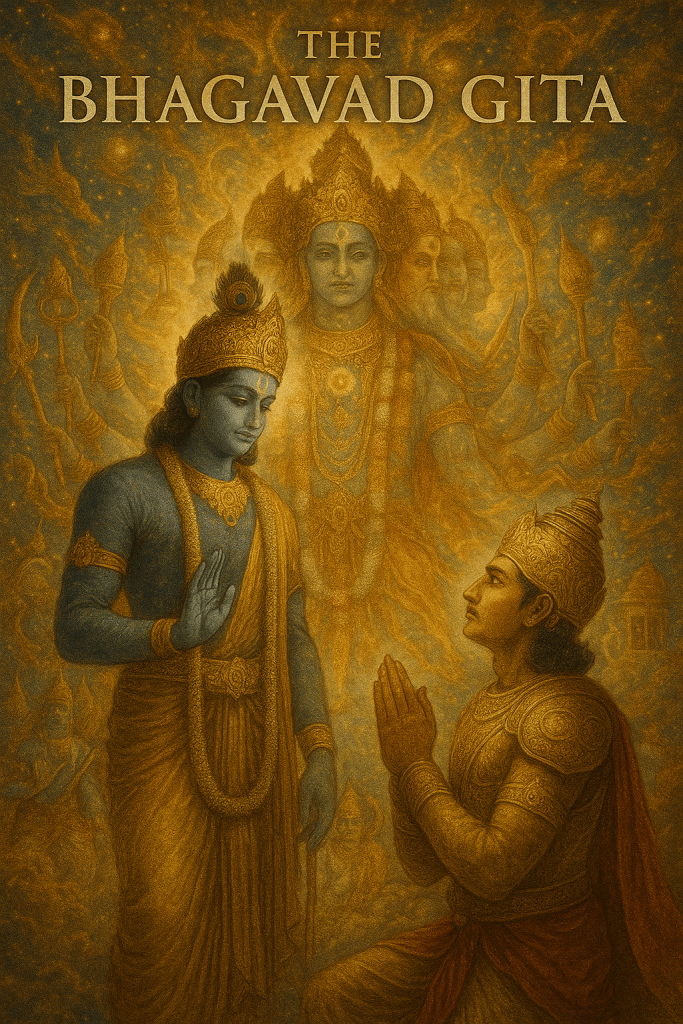
We live in an age where the search for meaning often leads us down fragmented paths. Yet, one text continues to illuminate the way. It does so not with dogma, but with divine insight. The Bhagavad Gita, the “Song of God,” is not merely a religious scripture. It is the distilled wisdom of the cosmos. It is a conversation between God and man. This dialogue is delivered by the Supreme Consciousness itself.
The Gita is not confined by time, tradition, or geography. It transcends religion, culture, and ideology. While it is a gift of Hindu tradition, it is universal. It speaks to the soul of humanity itself, offering a roadmap for inner alignment in the chaos of modern life.
🌌 The Voice of the Infinite
What makes the Bhagavad Gita unparalleled is its speaker. Krishna, the Supreme Being, orchestrates the rhythms of the universe. He steps into time to converse with the warrior Arjuna in the midst of a battlefield. But this battlefield is not only historical—it is symbolic of our own inner wars: confusion, doubt, fear, and despair.
In personal darkness, the Gita emerges not as a book. It becomes a living dialogue between the soul and the Source.
🧭 A Compass for the Soul
The Gita is a beacon in the storm—a cosmic compass for all who seek clarity, purpose, and peace. Its teachings are as relevant to the scientist as to the sage, to the seeker as to the skeptic.
Great minds across history have drawn upon its wisdom:
- Adi Shankara called it the manifest quintessence of all Vedic wisdom.
- Ramanujacharya saw in it the science of devotion, meant to free humanity from the forces that inhibit spiritual growth.
- Madhvacharya likened it to ghee—the pure essence extracted from the vast ocean of the Mahabharata.
And beyond the Indian philosophical tradition, it has struck chords in the minds of world thinkers:
“When I read the Bhagavad-Gita and reflect about how God created this universe everything else seems so superfluous.”
— Albert Einstein
“I owed a magnificent day to the Bhagavad-Gita… It was as if an empire spoke to us.”
— Ralph Waldo Emerson
“In the morning I bathe my intellect in the stupendous and cosmogonal philosophy of the Bhagavad-Gita…”
— Henry David Thoreau
“The Bhagavad-Gita… is a new message for every age and a new meaning for every civilization.”
— Sri Aurobindo
“It is one of the most clear and comprehensive summaries of perennial philosophy ever revealed.”
— Aldous Huxley
“When doubts haunt me… I turn to Bhagavad-gita… and I immediately begin to smile.”
— Mahatma Gandhi
“The idea that man is like unto an inverted tree seems to have been current in bygone ages. Plato provides the link with Vedic conceptions in his Timaeus. In it, he states…‘behold we are not an earthly but a heavenly plant.’ This correlation can be discerned by what Krishna expresses in chapter 15 of the Bhagavad-Gita.”
— Carl Jung
“To fully understand a creation as sublime as the Bhagavad-Gita, we must attune our soul to it.”
— Rudolf Steiner
🌱 The Gita and the Future of Human Evolution
The Gita does not ask you to withdraw from life—it asks you to engage more consciously with it. It does not offer escapism; it offers empowerment. It teaches us to act, not with attachment, but with wisdom. To live, not in fear, but in alignment with our highest self.
It is, at its core, a revolutionary guide for conscious evolution.
In a world starved of spiritual clarity yet flooded with information, the Gita offers something rare: truth that transforms.
🕉️ Eternal Relevance
The Bhagavad Gita is not just a book to be read. It is a mirror for the soul. It serves as a blueprint for action. It provides a meditation for the mind. It also offers liberation for the heart.
Whether you’re navigating the tensions of modern society, facing personal crises, or simply yearning for deeper meaning, the Gita calls out:
You are not alone. You are not lost. You are eternal.
Jai Sri Krishnam Vandhe Jagadgurum..🕉
(Salutations to the Supreme Teacher of the Universe)
 bramhajignyasa.com
Leave a comment